Tuesday, November 28, 2017

Opus IV Legend Review

Hey all, Eureka here with another Legend review. The last Legend review I did was really well received and I’m hoping to repeat that! Quick note: I will be analyzing cards mostly from a standard Constructed perspective, not in title series or Limited. Now, let’s get started. 

Caius – 5/10

Caius is a lot like Opus 1 Legend Lightning, a 6 CP Forward that will replace one of the cards you discard to pay for him with a good Summon. He can also turn around and use that card if you don’t find a good timing for it to nuke a 7000 or lower cost Forward, or combo burn to deal with a larger one. Situationally, Caius can be a very strong card. Unfortunately, I wouldn’t play Opus 1 Lightning-L in Opus IV and I won’t be playing Caius either. He is very expensive and as such moves very slowly, is vulnerable to Vayne (as well as Opus 1 Alexander and Ahriman, though I don’t expect these to see much meta play) and the Bahamuts he searches out are very expensive. Additionally, the general strength of Summons has fallen considerably this set with the printing of Clione and Celes, as well as the general difficulty of removing Monsters. 
That being said, all hope is not lost for Caius; he makes an excellent combo with Shadow from the set, allowing you to search out 9 CP Bahamut and burn for 9k with Shadow’s ability or just discard Caius himself for a solid 6k burn. He is also the first CP efficient target for Mog (XIII-2) aside from Gadot, which requires major deckbuilding changes to function properly. Caius may have some place in an Ice/Fire deck alongside Fang and Serah, given the XIII synergy that has been introduced to the set, but in the end he has pretty glaring weaknesses and came a little too late in the game for us to see his full strength. 

(All Ratings out of 10, 5 is Average Meta Card)
Power: 6
Utility: 4
Efficiency: 6
Ease of Use: 4

Sabin – 8/10

Sabin is a monster at applying pressure to your opponent. He prevents a Forward from being broken once every turn, and can even apply this effect to 2 Forwards if you haste him (with Goblin, Red Mage, or Belias) on the turn he comes in; this is pretty disgusting. His built-in combat trick makes him effectively unblockable without giving up a Forward and his S threatens to clear a board of Forwards every turn while saving himself. Sabin is at his best while swinging. You can pressure your opponent’s damage count and their board at the same time, which is both unique and very powerful, but Sabin is not without some pretty clear weaknesses, namely that his auto ability is pretty lackluster when you’re coming in on an empty board since he’s not great on defense as well as his susceptibility to Dull/Freeze effects. Amon, Genesis, Serah H, Jihl, and Canonneer really just dump on the card, since you get no value out of your net 6 CP investment for 2 turns. These weaknesses are par for the course on similar value-oriented 4 CP cards, and so this critique can be applied to many similar units, thought I imagine that Sabin may be good enough to warrant opening yourself up to those sort of soft-counters. 
Where do I see Sabin in the metagame? Either in Mono Fire or in Ice/Fire. With a Lebreau out and natural 9000 Power Forwards like Xande and Rubicante next to him (especially those which want to swing every turn), Sabin can really push advantages as well as safely use his S ability while preserving your own board. In Ice/Fire, he can be played in response to targeted removal (like Odin or Dragon) off of Devout to save your Forwards while receiving the full VI support package (Setzer, Cid, Locke) that can improve his consistency. A Gilgamesh Cannon-style deck might be able to support Sabin with efficient removal and Red Mage, but I can’t really grasp how that kind of deck would look quite yet, so it’s hard to say for sure. 

Power: 9
Utility: 8
Efficiency: 4
Ease of Use: 4

Celes – 6.5/10
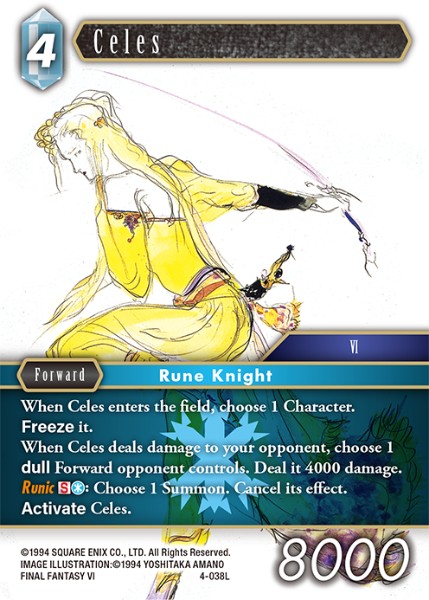
Woohoo! Finally a way to Freeze backups besides Rinoa’s Special ability. In all seriousness though, Celes has a lot of text for an on-curve card, but her strength comes from creating a tenser boardstate and disrupting your Opponent’s plays in ways we haven’t seen much of previously. Her Special straight up cancels Summons and in a worst-case scenario pays 3 CP to activate herself in Ice. She can put pressure on small Forwards and combo with cards like Cid Raines, Firion H, and other small-burn type cards to clear bigger threats. She can disrupt your opponent’s curve by Freezing a backup or hold off opponent’s pressure (Tempo flip) by freezing an opposing Forward or Monster. Celes’ strength comes from her versatility and the existence of effects that are very difficult to come by in this game. 
At her worst though, she is more or less an 8000 Power vanilla. No lie, when Celes is bad she’s very bad, since a good chunk of the time 4000 damage to a dull Forward will not be even close to clearing anything. So where do I think she will see play? Mono Ice is my best guess for her, though I could potentially see her alongside Sabin in a Fire/Ice build. In Mono Ice, her 4000 damage can be combo’d with Cid Raines, Genesis Avatar, Lich, and Laguna L to help her hold her value while keeping your board relatively safe from blowout Summons like Odin and Cyclops with her S. In Ice/Fire, she can come down along a Sabin or Setzer to start putting on the pressure. All-in-all, Celes is a solid card that could really end up either seeing lots of play or absolutely none at all, purely dependent on her effectiveness clearing Forwards in the meta and protecting your board from Summons.  

Power: 7
Utility: 9
Efficiency: 3
Ease of Use: 6


Locke – 8.5/10

This card is my wet dream, and anyone who knows me shouldn’t have expected me to say otherwise. The card is Serah S on crack, boasting an extra 1000 Power as well an on-hit ability your opponent can’t afford to ignore. He is on curve. If his first ability resolves, he breaks the curve by 2 CP (in line with Serah and a net 3 CP Zidane) while boasting similar Power and Genesis’ on-hit ability. Mirage Dive is really just the cherry on top; there’s no reason that line of text needed to be printed on the card for it to see meta play, but the fact that it’s there just makes Locke all the more appealing. 
Locke isn’t entirely with downsides though, at least for now. The biggest is that requiring 2 other Cat VI characters means that even if you have Cid (VI tutor backup) you still need to have a VI Forward other than Locke for his first effect to resolve, since the only other Cat VI backup is Opus I Kefka, shoeing us into Ice/Earth and making us pay for a relatively inefficient Backup. Fortunately, Setzer will usually search him out and set up for a good forced discard on the following turn (though Setzer will be open to removal and the discard is telegraphed heavily). I think that as the number of Cat VI Backups increases Locke will become a staple in every Ice-based deck, but for now he is relegated to decks that utilize the greater VI Ice engine (Setzer, Cid, maybe Celes and/or Umaro) and possibly other VI cards like dark Kefka, Sabin, et cetera. 

Power: 9
Utility: 6
Efficiency: 9
Ease of Use: 8

Onion Knight – 7.5/10

Let’s walk through the straightforward Onion Knight combo. You play Onion Knight L, add back an Onion Knight H or 3 CP Onion Knight R and deal 3000 to a Forward, then discard it for Job Change to swap out for 3 CP Onion Knight R and finish off the Forward with 5000 for a total of 8000 burn. So read that way this card reads “When this card enters the field, deal 8000 damage to a Forward” for 4 CP. That’s really good. The problem is that the deckbuilding you’ll have to go resort to for this to work consistently is pretty strict, meaning that rather than fitting into existing archetypes you’ll have to make him his own deck. I do think that card is fine on its own, as a net 4 CP 7000 Forward with an on-attack ability to deal 3000 and the potential to dodge removal being very much appreciated. 
So what do I see Onion Knight in? Honestly, his own deck. I do have a couple of crazy concept decks for this card (that I don’t expect to be successful at all) that will fall outside of the expected ‘support zone’ for him (Mono Wind splash Lightning, Wind/Lightning, and Wind/Fire), but I don’t see him sliding into existing archetypes the way that other Legends have up until this point. 

Power: 9
Utility: 7
Efficiency: 9
Ease of Use: 1

Fat Chocobo – 6/10

Aside from Izana I think this is the best Chocobo card to date... Not much of a contest there, though. The card has a plethora of search options, but I imagine most Chocobo decks will be heading for either the buff haste-giving one (6000 Power) or straight Haste. If you are going for the Chocobo strategy either way, it’s obvious that this card will be a fantastic addition, giving your Chocobos combat tricks and allowing you to develop board and economy simultaneously, but in all honesty, I just don’t think that the card is what is going to justify the engine. Haste-centric rush decks that best utilize Chocobos aren’t really looking to put out heavy economy in the early game and the card is most efficiently played after putting down a 2 CP Backup down on turn 1. Decks that aren’t focused on putting early pressure won’t benefit from the Chocobo card quality, leaving this card in a bit of a rut where the game is right now. 
Fat Chocobo is a good card, but I'm not convinced it has found the right value / CP efficient 3 CP Chocobo that will justify a slot in Wind archetypes in the coming meta. There is a chance it will see play regardless, but given the amount of good Forwards Wind has right now I don’t think that there will be room for Chocobos unless you are really committed to it. I do think a lot of it's success depends on how reliably you can set up Nono and this card together, since it effectively becomes a +2000 Power boost to as many Chocobos as you can swing with as you want. The potential for the card to be great is there. 

Power: 7
Utility: 6
Efficiency: 6
Ease of Use: 5

Kefka – 6/10

Kefka L has a lot of flavor and boasts a very powerful effect, but unfortunately he is the lesser of the two Kefkas in the set. The combo potential on him is enormous, and his removal is simply effective. He is a clearly powerful target for Magic Pot, which already has synergy with cards Kefka can combo with such as Opus III Sephiroth, Rinoa, and Golbez. Master has shown us that Ice/Earth/Lightning was reasonable in the Opus III meta at Worlds and Kefka L is a clear reason to believe that it’s possible again in the future. Kekfa L is a fine addition to this combo-oriented style of play, but is not particularly CP efficient and he is probably the clunkiest of the Opus IV Legends. At his worst, he is just an unplayable 2 Earth CP card. Without a decently developed board and economy he is just too expensive to play reliably, and this is by far his greatest weakness, especially considering how cheap and efficient cards in Opus IV are so far. 
Japanese players’ Twitter analysis of the card comes in clear here: It seems like you could do some really dirty stuff with this card. But in the end he is a combo card and too hard to justify using in an undefined format that hasn’t been researched thoroughly. His potential card power is huge though, and if he can find a place in a refined, reliable combo deck (the likes of which we haven’t really seen since Opus I Golbez archetypes) that can survive in the current meta, he will certainly be one of the most potent swing cards.

Power: 10
Utility: 5
Efficiency: 5
Ease of Use: 2

Shantotto – 4/10

So, is XI going to be the most expensive title deck or what? 2 Prishe L, 2 Shantotto L, Shadow Lord… Who knows what’s coming our way in future sets. Anyways, Shantotto is probably the card I am most disappointed about in this set. Her effect is unique and on the surface looks like it has tons of combo potential, but you’ll find that these combos are so inefficient and, more importantly, decks that build wide boards are mostly immune to Shantotto’s ability since they will be utilizing a lot of Monsters right now. To top it off, the decks that Shantotto looks like she would be most effective against (Lightning and Fire focused removal decks) both look like they’ll be utilizing Ice to combat cards like Shantotto, to which she is completely vulnerable. 
Still, let’s look at some of the good things she has going for her. She soft-counters the Al-Cid combo, and is generally difficult to remove for Mono Lightning and Mono Fire decks, which were very powerful up until this point. Additionally, Fusoya H is a great option for her, allowing you to play an efficient 7000 wide nuke that will clear of most 3 drops in the game, provided they are not power buffed. But, that’s still a total of 7 CP in one turn, and you nuke your own side of the board; this means that you are essentially paying the same 7 CP you would for Backup Shantotto and developing a vulnerable board instead of safe economy. She is much less CP efficient than other powerful board nukes like her Backup self, Exodus, Zalera, and now, Sabin. More importantly, she is awful at fighting relatively even, combat-trick driven board states and is directly countered by Sabin. Shantotto had a lot of potential, but her incredibly high cost is just too much of a CP investment for a card that can be countered by any Dull/Freeze effect and one of the more popular Legends coming out.

Power: 7
Utility: 3
Efficiency: 3
Ease of Use: 3

Raiden – 3/10

Bahamut, but sometimes better and sometimes worse. Bahamut rarely sees play and I do not expect Raiden to be any different. Lightning is not short on good removal cards, particularly ones that are much more efficient than this one. They have one of the best board clears in Grand Cross Exdeath (the only one that can clear Monsters and Backups!), a plethora of 1:0 trading tools (Gilgamesh S, Edea, Al-Cid), efficient instant removal (Exodus, Odin, Cyclops, Dragon) and there will just be no room for this card. The card art is beautiful and I expect this card will be amazing in Limited and in title series (the same way Bahamut is) but it’s just too expensive for constructed formats in which ETB abilities and efficient Forwards dictate the meta.

Power: 6
Utility: 2
Efficiency: 2
Ease of Use: 2

Lightning – 8.5/10

Lightning is one of the most powerful aggressive cards we’ve seen printed to date. Starting with her drawbacks, she says that you have to have a XIII Forward out… The Category XIII limitation is just to say that you are shoehorned into playing Mono Lightning (Rygdea, Gilgamesh S) or Ice/Lightning (Serah H, Serah S, Cid Raines, Snow, Rygdea, Noel) for her effective to go off, and is effectively a non-factor a good chunk of the time. (EDIT: It has been pointed out to me that Lightning's restriction is Character, when I had been reading it as Forward. This just makes it an even bigger non-factor.) Lightning is at her best when played onto a board that is effectively in a stalemate due to power discrepancy between the relatively low Power of your Forwards, and in a lot of ways is like a Hasted Amon that can attack while getting both dulls in, for 1 more CP and 1000 less Power. That’s pretty good. I haven’t even mentioned the part where she can dodge removal by discarding a copy of herself and to remove and flash herself back in, getting another Dull in the process.
All in all, Lightning is the card I’m expecting the most from in this set. She’s the best game closer we’ve seen to date (aside from Rinoa I guess? Not that they’re really competing for the same spot) and speeds up the rate at which Mono Lightning and Ice/Lightning will play at immensely. As a side note, I think that this Lightning will be what really breaks title series over the edge and puts XIII in a clear lead over the other series. 

Power: 10
Utility: 8
Efficiency: 5
Ease of Use: 8

Steiner – 7/10


I feel the same was about Steiner as I did about Genesis in my last Legend review. He’s just solid. He’s what Mono Water is asking for right about now: a decent 4 CP Water Forward. He is good at catching up on the board, allowing you to trade damage for economy early and play efficiently when you hit 3-4 backups (Mono Water’s vision) by building a board of cheap Forwards with an above-average power level for their cost. He soaks up Al-Cid combo pressure that your opponent would like to put on Garnet or other value-focused forwards by allowing you to Dull them for his ability at instant speed as well. Unfortunately, 5 CP Steiner is also quite the beast, and while I don’t expect them to really compete with each other’s slots (they both easily fit into the deck’s image and are played at different points in the game), it is a technical downside. All in all, I fully expect Steiner L to see play alongside Beatrix in Mono Water decks that are skipping out on Monsters in favor of the IX engine and Light Zidane, but he doesn’t look good enough to make me want to skip out on the Monster package just yet. As such, his competitive usage will more or less depend on successful Water-focused monster decks are in the upcoming meta, rather than his own merits. 

Power: 6
Utility: 6
Efficiency: 8
Ease of Use: 8

Mira – 7/10

Mira and Relm are the new utility 2 CP Water Forwards for the set. They both support monsters, but I think the Legend kinda got the short end of the stick here by just a bit, though I do think both of them will be played as (probably as 3-ofs) because they both support Monsters so well. Mira gives you a 1 CP discount on all Monsters, meaning that she buys herself back if you can play 2 before she leaves the field. She also has the potential to generate extra cards each time you break one of your Monsters (Dragon, Goblin, Flan, Tonberries and Adamantoise all come to mind as good targets), buying her own CP cost and card back after 1 and 2 searches (without counting discounted monsters) respectively. The fact that she dulls herself is, in fact, a good thing; she can save herself from being the target of an Al-Cid combo or other various Lightning removal.
I've talked up the strengths of this card because if she remains untouched over a couple of turns or more she can just be a total beast by gaining you an insurmountable advantage, but if she's removed before you can get the value out of her albeit small investment, she's just a 2 CP 5000. This is a pretty small investment and so I see no reason not to take that risk, but comparing her next to Relm (who has a good chance to replace herself immediately, animate your monsters, is an EX Burst, and is Category VI to boot) she can seem a little more lackluster. All-in-all she is a fine card though, and I expect to see her around as long as Water-oriented Monster decks are a thing (read: until something else better happens). 

Power: 8
Utility: 8
Efficiency: 6
Ease of Use: 7

Terra – 6/10

Terra may be the card we need for Summons to actually continue to see play over the next format. With all the anti-Summon effects printed in the set and the fact that a good amount of Monsters do the same thing as Summons, it isn't at all unlikely this carded really needed to be printed now or never. However, I can't help but feel like it's just a little too late. Terra sits a full 1000 Power below the curve despite being a Light card, sitting at a net 4 CP 7000. Her S ability is good and offers the ability to search Ultima, but that ability itself costs a net 2 CP and Terra has to dull herself, meaning even if you grab and play Ultima that turn you're giving up a damage for the turn and essentially forfeiting the 6000 damage from her ability a good amount of the time. Of course, you don't have to grab Ultima; there are plenty of good Summons in the game for her to choose. Because Terra's other cards are in Ice (along with a good amount of the VI support engine), Zalera and Shiva stick out at me as the other ideal targets for this card. Unfortunately, VI-centric Ice doesn't look to be utilizing Dulling effects as heavily as XIII-based versions of the elemental archetype, and won't benefit from Zalera as easily. 
Terra is a very fine card and is easily a throw-in in any deck which highly benefits from high-impact summons as long as it's not running any other Light or Dark cards, but realistically she feels like an Opus II or III card that just got pushed back and sits below the curve now. The pure utility power of searching for any Summon while remaining color-neutral means that she will see play now and probably in the future, but I can't really see her finding a place to shine the way she would have if she was released earlier. 

Power: 7
Utility: 8
Efficiency: 5
Ease of Use: 5

Shadow Lord – 8/10

When I first saw this card I didn't really think much of it. I figured that Knight would be out of the metagame and that Ice/Earth would shift away from much of the Shelke-focused gameplay it had in favor of a slightly bulkier, VI-centric approach (if it remained a top tier archetype at all), and that 2 CP Forwards would not be as prevalent in the meta. Looking at the entire setlist now, I think that my initial impressions were wrong. I expect Yang/Ursula to continue seeing play in Earth because, frankly, I don't think Earth got much good stuff in this set. I think that Mira and Relm will both be staples in the Monster-focused Water decks and that non-Monster Water decks will continue to utilize Knight and possibly Ephemeral Summoner. Llednar is good as well, and I would be surprised if he is not in every Fire archetype this set. This means that Shadow Lord will generate at least 2 CP of value from your opponent a pretty good amount of the time, which is good. His main drawback is that he a Dark card, but other small drawbacks include having to wait for the optimal timing to be played and that he can't be searched out, so when you slot him as your tech and don't have him it'll be quite frustrating to be missing the punish. His last ability, while potentially helpful in decks that are heavy-removal focused like Mono Lightning and Mono Fire, is not very important, but helpful.
Running the numbers real quick, his net CP is 4 at 1 kill (which is fine), 2 at 2 kills, 0 at 3 kills, and.. Let's just stop there and briefly mention that this is also a Golbez counter. That'll do.

Power: 9
Utility: 7
Efficiency: 8
Ease of Use: 7

Sunday, November 19, 2017

Brief Introduction to the Japanese Playstyle and Mentality

Introduction

Hello, my name is Jared Wallace, known primarily online in the FFTCG community as Eureka. I have been playing FFTCG since Opus I and adopted the Japanese playstyle as soon as I picked up the game by reading Japanese articles, analyzing decklists, watching Masters, and listening to (or reading) interviews of Japanese players. As you might have guessed, I am a strong advocate for the Japanese philosophy and playstyle in FFTCG and would like to share that with other people in the Western community. I feel I am fairly well-versed and qualified to do this, but I do not intend to represent myself as an expert on Japanese FFTCG or the Chapters game; I obviously do not represent every Japanese player and what I am writing is my own personal interpretation and philosophy based on and shaped by my interaction with and analysis of FFTCG in Japan.

Before I begin, I think it is necessary to say that it is not my intention to negate the viability of any playstyle by advocating this one. I strongly believe that there are many ways to think about this game and that new deckbuilding styles, tech choices, and approaches to the game are what keep this game fresh and attractive to us all. My intent is not to stifle creativity, but to provide a structure to players that are lacking one or are looking to expand their understanding of the game. Whether you are a spike, a master brewer, or a brand new player, I hope that this article can expand your thinking and inspire you to try new things, the same way that other content creators have inspired me. For that reason, I ask you to buy in to what I am writing, and not negate it on the surface level because it clashes with your personal views on the game.  

Part I: Playstyle

It is important to start by understanding the Japanese playstyle’s general vision for a game when discussing it's other principles. Without it, it is impossible to understand individual decision making, card analysis, and deckbuilding choices. I have noticed that people at my locals and that interact with online tend to think about their gameplan in terms of cards that have synergy with each other, such as small (5000-6000) burn effects comboing together in Mono Fire, or running Refia into the DGS chain. While this is not a wrong approach to deckbuilding by any means, this is not what I mean by your gameplan. What I mean is how you tend execute your first few turns regardless of opening (or not opening) a particular card or combo. For example, Mono Lightning tends to rush up to 4 backups and focus on removal elements (such as Al-Cid and Edea) and Red Mage to keep the opponent down and win a damage race. 

In the Japanese playstyle, decks tend to try to play up to a certain number of backups before playing out Forwards, usually this number is three or four, but it can vary depending on archetype and tech choices. Obviously this is only done when possible; if you don’t draw an ideal backup curve you can’t play out to that many backups, or you might be forced to respond to an opposing rush (looking at you Chocobos) with your own Forwards and alter your gameplan, but the vision for an ideal game in the Japanese playstyle usually dictates playing out three or four backups and playing out Forwards or potentially more backups from that point on. Why is this? The answer is surprisingly simple: if you play backups first you will generally be able to play all of the cards in your hand efficiently and will not run into dead draws as often. The more backups you have the less you will end up paying for 3 CP cards inefficiently, and the easier it is to pay for more expensive, powerful cards. It is also the reason 2 CP backups are very common in the Japanese playstyle as opposed to value oriented ones; you generally want to open and immediately play more on average in order to mitigate the risk of opening backups you are forced to play inefficiently, namely 3 CP backups.
At the risk of sounding painfully obvious, it is logical to say that the longer a game goes on the player with more backups is generally favored. Why? Because they will be paying CP more effectively than the player with less backups, discarding for CP less often and having a card and (usually) board advantage. The other main reason low backup openings are less favored are because early EX Bursts, particularly powerful ones such as 7 CP Odin and 3 CP Leviathan have a tendency to flip the game completely in the opposing player’s favor.

Backups aside, the Japanese playstyle tends to be centered on playing cards efficiently to preserve card advantage. Players tend to think two or three turns ahead about how they can efficiently play a card and choosing lines that allow them to maintain a consistent card advantage, rather than ones that may have a big payoff by putting a lot of pressure on your opponent but can be punished by removal, such as an opposing Al-Cid combo or Shantotto. For example, a Mono Ice player with the hand 1 CP Summoner, Opus 3 Time Mage, Kuja L, and Zidane S with three backups on board may elect to play the two backups to play Kuja and Zidane efficiently together (at exactly 5 CP all paid on board) next turn rather than running out the Kuja and discarding a card for Zidane to put extra pressure on the opponent at risk of Kuja being removed and losing out on pressure and card advantage.

Another example of thinking about removal efficiently is the emphasis on 1:0 trades and their prevalence in the Japanese metagame. Al-Cid, Edea, Xande and Sazh combo, Cuchulainn on trades, and many more all demonstrate this very important principle. These are not ‘control’ elements, they are just looking to peel off card advantage from your opponent and inch your way into a lead. In that way it is important to understand that, from this perspective, FFTCG in its current iteration is not a game of consisting of aggro, midrange, combo, control, and tempo decks the way that Magic and other similar TCGs are. FFTCG is a game of efficient play, it is a game of inches in which either deck can win regardless of hard counters and tech choices the other may have based on how well each player can squeeze out advantage over time through trading and playing efficiently. As a brief side note, I believe this is the most controversial statement I will make in this article and I ask that, whether you agree or not, you humor me and continue reading.

Part II: Card Analysis and Deckbuilding

Now that I’ve explained the Japanese playstyle, I can start to explain what types of cards are valued and why Japanese deckbuilding looks the way it does, but first I will briefly explain the concept of ‘net CP’. Because all cards (except those of Light and Dark element) can be discarded for 2 CP in this game, every card played carries an additional cost of 2 CP, because it can no longer be used to generate CP. Let’s take a brand new Opus 4 card, Magic Pot, for example. It is a 1 CP Monster card, but playing it to the field costs the card itself, meaning the card actually costs a net 3 CP. Playing a 4 CP Forward such as Tidus L generating CP from your hand makes you lose two cards and the Tidus L, meaning you lost a net 6 CP to play him. This concept is important when analyzing cards, as cards in this game often have a way of not really costing as much as written on the card.

Let’s look at some examples of that, starting with perhaps the oldest and most basic example: Serah S. Serah is a 3 CP Ice Forward with 6000 Power and the effect “When Serah enters the Field, your opponent chooses 1 card in their hand and discards it.” I have watched many a people look at the card and say “a 3 cost 6k is below curve”, dismissing the card, but let’s take a look at her net CP. Serah costs a net 5 CP to play but takes away one card from your opponent, making them lose 2 CP in resources; in this way Serah’s net CP cost is really only 3 (as long as her ability resolves). This means Serah is significantly above the curve at 6000 Power, with the majority of other net 3 CP cards being 1 CP Forwards such as Tsukinowa, Yuffie, et cetera. Obviously Serah is not the only card with these kinds of upsides, Zidane S is ridiculously above the curve offering the same net 3 CP as Serah but offering flexibility with a draw or discard as well as sitting at 7000 Power, comparable to Famed Mimic Gogo but without a downside. Steiner is a net 5 CP card, his own card being replaced by the card he tutors while offering EX Burst, search consistency, and feeding the IX engine. He even makes Zidane a net 2 CP 7000 card! Other notable cards functioning similarly which have above-the-curve net CP are Lenna + Gogo/Knight, Paine, wind Zidane (when his buff is up), and Squall R + Laguna R combo.

Let’s take a look at some less intuitive examples: cards which remove your opponent’s resources. Al-Cid is a ridiculously overpowered card in this regard, allowing you to remove an opponent’s Forward of 6000 (6000 to 11000 range depending on your combo piece) and play an additional 3 CP Lightning Forward in addition to his 6000 Power body for a net 8 CP before calculating resources taken away from your opponent by removing their Forward. This highlights another important concept to think about during both gameplay and deckbuilding: depending on the net CP cost of the Forward removed by the Al-Cid combo his net CP (and therefore efficiency) change. Let’s dig a little bit deeper here with a gameplay example: pretend there are two Mono Lightning vs. Wind/Water matches happening right next to each other. One Wind/Water player has a 4 CP Wakka Forward on the Field, and the other has a Zidane S on the field. Both of our Mono Lightning players make the obvious play, clearing the opposing Forwards with an Al-Cid + Onion Knight combo. Assuming all other board factors (Backups, Forwards, etc) equal, which Mono Lightning player had a better exchange? It may be obvious, but the one who killed Wakka came out ahead. That Wakka cost a net 6 CP for the first Wind/Water player to play to the Field, while the Zidane S only cost the second Wind/Water player a net 3 CP (or 2 if they played it discounted). This means that the first Mono Lightning player played his combo for just net 2 CP while the second played his for net 5 CP (or 6 if the Zidane was discounted). The implications of this are huge for deckbuilding, namely that the more value oriented and less efficient the cards in your deck are, the more vulnerable your deck is to efficient removal, and the more card advantage you lose when they are removed. This amplifies how much 1:0 trades hurt in-game, and is huge factor in Japanese deckbuilding.

The last thing you will find that all decks have is a source of power superiority, in order for your Forwards to push over your opponent’s. Mono decks will use their corresponding powerboosting backup (Lebreau, Lulu, Duke Larg), decks with Wind in them will use Maria, dual color decks will generally look for something else in their element (Cyclops for Lightning, Zack, Selphie, Belias, and Cloud C for Fire, Gippal and Golem for Earth, et cetera) so that they can push their Forwards over their opponent’s for damage. Many decks will have multiple sources of power superiority. Decks without a clear source of power superiority tend not to see much play (Ice/Water is a notable example in personal testing) because their attacks are vulnerable to getting walled out by defensive Forwards.

Conclusion

In sum, the Japanese playstyle and deckbuilding generally tries to avoid playing cards which are vulnerable to removal and therefore combines mostly net CP efficient cards with removal and power equalization (such as Cyclops) in order to press both card and potential damage advantage. Backups are heavily emphasized early in order to maximize CP efficiency and mitigate the risk of losing the game to potentially game-changing EX Bursts. A combination of net CP efficiency and backup emphasis generates card advantage naturally as the game continues and eventually the overwhelming card advantage will generate a board discrepancy in which the game state breaks as a result of aforementioned removal or power superiority resulting in a win.  

While not a complete overview, these are the points of the Japanese playstyle and deckbuilding mentality that I think are the most important to discuss and that most aspects of FFTCG can be discussed strategically in these terms. If you feel I have missed something, misunderstood something, have anything to add or anything you would like to ask a question about, please let me know. I'm always looking for feedback and for new ways to think about the game. 

Till next time!

Friday, August 11, 2017

Novel (Yokohama Masters Champion) Hobby Games Interview Translation

Preface
Hello everyone, this is the first post I’m going to make on this blog because it’s the first thing I’ve worked on that I can’t post on Reddit easily. If there is interest in this kind of thing I would be very open to doing more translations and/or providing my own thoughts on the game in the future.
The original article can be found here and is property of the author (Taruho) and Card Gamer of Hobby Japan. I do not own anything and my only intention in translating the article is to make it more accessible to the English-speaking FF-TCG community; if, for any reason, Taruho or Card Gamer desire for me to take down this post I will do so immediately.
Lastly, I would like to express that I have no formal training in translation and have only ever done so as a hobby, so I ask that people be patient if parts of the interview have awkward grammar or are otherwise difficult to read.
/u/EurekaMinus
@EurekaMinus

The article and interview begins here.

---------------------------------------------------------------

◆Beginning
Nice to meet you everyone.
I’m the FF-TCG player known as “Taruho”.
I have the pleasure of playing with my friends over SNS and attending Masters and other large FF-TCG events.
It may seem like an obvious question, but have you ever fought against a deck you didn’t understand or anticipate the moves of at an event before?
Have you not thought about the concept of the deck you were playing against, or what you could do to win against it?
In this article we will address questions like “How was that deck made?”, “Why is that player so good?”, “How can I become better?” with players I’ve met as well as their thinking during deckbuilding and play, and the strength behind it.
This time I have the pleasure of presenting you with an interview I conducted with novel, winner of last week’s Masters Yokohama.

Novel
A formidable player who has taken major titles at Masters Yokohama and Tokyo Opening Tour. He is an FF9 fanatic who has a collection with 9 foil copies of various FF9 cards.

▲novel’s beloved FF9 collection

◆Why did you decide on Ice/Lightning? Why are aggressive decks dominant in early metas?
――
First of all, congratulations on your victory at the Yokohama Masters. Now then, what kind of circumstances led to you choosing Ice/Lightning as your deck for the event?
novel:Thank you very much. I actually used this Ice/Lightning deck which existed before the Opus III meta because I thought Water-based decks would be popular (for the event).
――Actually Mono Water won the Masters Sendai event which took place just one week after the release of Opus III, and there were multiple in the Top 8 of Yokohama.
novel:That brought my attention to【3-037H】Zalera, the Death Seraph. This summon can break all of Mono Water’s core Forwards, including【3-139C】Knight,【3-129L】Garnet, and【3-144L】Lenna. This single card can compete with Mono Water’s development and recovery power, and I decided I was going to use this card (at the event) because of that.


――Then, why did you decide on Lightning as your secondary Element?
novel
: After deciding to focusing on Zalera and Ice as the main element, I tested builds for Fire/Ice, Ice/Earth, and Ice/Lightning.
First, in Fire/Ice, I looked at utilizing【3-012L】Zack to empower Forwards who have already used their abilities once placed on the field, like【1-195S】Serah, and rely on support cards like【2-009R】Selphie and【2-009R】Belias to continue attacking.


novel: Ice/Earth has a similar strong point, using cards like【1-101R】Gippal and【1-106C】Golem to raise Forwards power to make a push. Returning【1-101R】Gippal to the Field with【1-048C】Devout is another powerful combo.


novel:Ice/Lightning had great synergy between【3-037H】Zalera, the Death Seraph and【2-098L】Amon, which allowed me to dull Forwards at instant speed. By using this card (Amon), I was able to amplify the effect of【3-037H】Zalera the Death Seraph’s ability in a way that was not available in other Elements. Because【2-098L】Amon is still very powerful on his own, the deck’s construction didn’t become warped just by trying maximize the effects of this combo.
Additionally, while it isn’t possible to the raise the Power of all of your Forwards in Ice/Lightning,【2-107C】Cyclops lowers the Power of your opponent’s Forwards and lets you fight on the same Power discrepancies as you would by using other Elements. The ever-popular【2-097H】Al-Cid and his power to develop a board while removing your opponent’s meant that Lightning provided great synergy with key cards, attacking power, and development, which led me to feel it had more potential than other Elements for this particular deck.


――Did you consider Mono Ice as a possibility?
novel
:Mono Ice would have provided a certain amount of security, but I felt like there were problems in its ability to respond (to the opponent’s plays). Zalera has problems breaking even-costed Forwards, and popular Mono Water deck play some cards like【2-121H】Ashe which allow them to Activate their Forwards, so I decided against it. As it turns out, on Day 1 ended up playing against Mono Ice and getting totally crushed by it.
――Out of the remaining two Elements, I can’t really get a grasp on how a Wind/Ice deck might work, but in Ice/Water you would be able to search
【3-030L】Kuja from【3-127R】Eiko and cast【3-032R】Shiva with【3-129L】Garnet; it seems like it might be a fairly effective deck. Did you consider it at all?
novel
:I did think that Ice/Water may be a good control deck. However, in early metas there are a wide variety of decks, and because of that building responsive control decks is very difficult. It isn’t possible to perfectly foresee the speed of aggressive decks and prepare for the Power levels of core Forwards (in a diverse, early meta), things which are critical to building control decks. Because of this I chose to forego Ice/Water for a more proactive deck.
――Many people had the mentality that Mono Water was very strong going into the event. You ultimately decided on using Ice/Lightning to oppose Mono Water, but there are other players who were choosing between using Mono Water or instead (like you) using a deck effective against Mono Water. Did that worry you at all?
novel
:I can only really say this about the Yokohama Masters, but because the meta is still young and there haven’t been many events to date, even if people have the information that Mono Water is strong there are still many people who haven’t had the chance to play against it extensively. In the end, people are making decks using cards that they’re paying real money for, so even if they are the type to make counter-strategies, when they hear that a deck is strong it’s human to want to take it to a tournament at least once, or so I think. Because of this, even though we had information that Mono Water was strong based on the Sendai Masters the week before, most people still wouldn’t move on to countering it.
――This Ice/Lightning, what kind of interaction does it have with decks designed specifically to defeat Mono Water?
novel
:The combination of Dull, Freeze, and Zalera’s effect to Break Forwards means that as long as an opponent’s deck isn’t comprised completely of even-costed Forwards it can still be played to great effect. Also, even if Zalera doesn’t have a strong effect against a certain deck there is always the possibility of pushing through with Discard effects, and so I don’t think the deck has any particularly poor matchups.
――I’ve heard that you’re a very passionate collector of FF9, did you not consider building a Fire/Water deck?
novel:Actually, during preparation I was using Fire/Water deck chalk full of FF9 cards. But then I realized that Zalera would break all of the FF9 Forwards. Because of that, I had to squeeze the cast down to just the rivals, Kuja and Zidane.  
――How was it using
【3-030L】Kuja?


novel:He can be considered weak because he lacks an ability when played onto the field, but I think he’s actually a very strong card. While it’s true that there’s a bit of a time lag before you can use his abilities, because the meta is currently centered around Water he often isn’t immediately broken, and there are a number of opportunities to use his abilities. Additionally, when your draws are weak he provides an opportunity to use your CP efficiently and reduce turns in which you would otherwise be doing nothing. The winning deck at Sendai Masters played a single copy of【3-146H】Minerva; the single copy of Kuja is similar in that it is very powerful after you’ve both used up your hands.
――It’s a little off topic, but what do you think of【3-146H】Minerva?


novel:In the current meta it’s mutually understood that within Light and Dark Element cards【3-154S】Zidane is the single best card, but I find Minerva to be a perceptive choice. If returned by【1-178R】Leviathan or otherwise dealt with immediately after coming out it can be a huge loss, but if you can play it after forcing your opponent to use up those kinds of answers it can definitely cover those weaknesses. It might see popularity as a tech for Mono Water.
――
Do you think its play will be limited to Mono Water?
novel
:I do think that it could be effective in other decks. For example, coupling it with【2-147L】The Emperor could be very strong. However, in Mono Water even if you end up drawing Minerva first, you can search Zidane out and put him onto the Field beforehand. I think that kind of flexibility allows it to be particularly effect in Mono Water. Earlier I said that I had foregone Ice/Water, but it might be possible if using her (Minverva’s) power to strengthen your Forwards. This seems like something that is worth researching.
◆Thinking of cards in ABCs? Let’s ask a veteran player about deckbuilding!
――Looking at your decklist this time, there are many cards that you’re playing 3 of and others you only play 2 of that might stick out to some people. If there are things you think about during deck construction would you please tell us about them?
novel
:I originally had 3 copies of【3-154S】Zidane in the deck, but when you open up 2 of them in your opening hand it’s incredibly bad. Especially when you’re going first and on the offensive, often times Zidane ends up not being broken and staying on the field, rendering you with the extra copy stuck in your hand. In terms of raw card power I would play 3 without complaining, but I decided on playing only 2 because of his Light element.


――Could you tell us about your criteria for card selection when putting together a deck?
novel
:When selecting cards I tend to list card in terms of priority and decide that way. Taking my deck for this event as an example,【1-042R】Squall,【1-059R】Laguna, and【3-037H】Zalera, the Death Seraph are the key cards, and so I put 3 of each into the deck. They are, for example, “Squall A”, “Squall B”, and “Squall C”. If you think of it like this it’s more like Dragon Quest than Final Fantasy.
Moving on, I had originally put 3 copies of【2-098L】Amon in the deck as well. However, Serah A was stronger in terms of the deck’s direction than Amon C. Similarly, Zidane A was stronger than Serah C, and Al-Cid A was stronger than Zidane C. Following this pattern, I was quickly able to decide how many of each card to put in. The last slot was a competition between【3-033L】Genesis B, 【2-047L】Rinoa C, and【3-030L】Kuja A, with Kuja A emerging the victor. It’s good to put 2 copies of powerful cards into your deck, but when it comes to that card’s C, or 3rd copy, I try to think if a certain card’s A is more powerful instead.
――As a result of that thinking cards with special abilities like【2-047L】Rinoa end up only having 2 total copies in the deck, does that not have an impact on your deckbuilding?
novel
:That tends to vary as to whether that card can be searched or not. This deck doesn’t have a way to search (for Rinoa), so it’s hard to plan to use her special ability. With packages like【1-204S】Jessie and【2-077L】Vincent, you can plan to use their special abilities ahead of time during deck construction, but I didn’t really think about doing so this time. Even if I were to plan for it, I think that Kuja A was still stronger than Rinoa C.
――You mentioned that【1-042R】Squall and【1-059R】Laguna are key cards in the deck, but you didn’t opt to include【2-048R】Rinoa in the deck. There was also an Ice/Lightning deck at the Grand Championship Nagoya which utilized【2-048R】Rinoa.
novel
:Actually, that list was a deck that the user, Sid and I had prepared together, but it was prepared specifically with the Grand Championship tournament format in mind.


The first day of the Grand Championship has 7 Swiss rounds and the second day has, at longest, 4 more Swiss rounds and best-of-3 rounds in the playoffs; it’s a really long tournament. In tournaments with a lot of rounds like this, the possibility of bricking and dropping games as a result increases significantly. Including【2-048R】Rinoa in that list was part of a strategy which involved using search cards like【1-196S】Mog [XIII-2],【2-106R】Gramis, as well as effects that allow you to retrieve discarded cards like【1-133C】Sage to reduce the risk of having games in which your draws are so bad you end up losing.
【2-047L】Rinoa’s ability is incredibly powerful, and when she is on the board she can completely flip a game or let you push on otherwise impossible to manage boards, but we thought that including a card which drew out 70~80& of our deck’s power instead of one with an explosive effect was more important for that tournament. It kinda feels like we’re walking alone in “I won with this crazy deck I made the morning of the tournament”, but our card selection was actually a result of a lot of thinking. In contrast to that (the Grand Championship), the Yokohama Masters wasn’t a very long event and I chose【2-047L】Rinoa instead.


◆Making an unexpected deck, and “Simple Game” mentality
――
You mentioned that you made the deck together, but how do you normally come together to make decks?
novel
:In the end we usually meet up and practice together in person, but lately we’ve been using LINE to call and play against each other.
――How do you normally play on LINE?
novel
:Normally we just say stuff like ”Discard ‘XX’ and ‘YY’ to play ‘ZZ’. End turn”, talking to each other in order to play. At first we were using webcams on Skype to play but one of us ended up saying “Do we even need the camera?” So we tried just using audio and it was fine. By playing with a simulated board in our head instead of looking at an actual one, we were able to avoid misplays that come from things like overlooking parts of the field or break zone, and that had a big part in improving our skills.
――A while back you mentioned that early in the meta it’s better to play aggressive decks, but, for example, just before Opus IV and players have more experience, how does this change?
novel
:As meta research progresses straightforward aggression reaches its limit. It might be true that there is a gap between players who don’t make mistakes or minimize their mistakes and the ones who do which ends in the former winning, but it isn’t so simple as to just do that (make less mistakes). I think that when the meta reaches that point it’s necessary to find some kind of breakthrough, or an unexpected way of fighting.
――This “unexpected way of fighting”, I feel like it’s the polar opposite of the security-focused approach you were talking about before.
novel
:That’s exactly right. It’s about forsaking risks. Going based on your results and using a deck you’re practiced with, or reducing the power of your deck a bit and finding some kind of unexpected tech that will let you reduce the impact of your opponent’s experience. My personal thought process is that in a meta in which all possibilities have been thoroughly researched, finding unexpected tech is slightly better than a secure deck. To put it another way, in early metas you should use people’s lack of experience to your advantage, and in developed metas you should use everyone’s ample experience to your advantage. Aside from your deck choices and play this is the most important thing when going to an event, so I want people to think about it.
――When you won the Opening Tour Tokyo tournament you had brought an Ice/Earth Hand Destruction deck that hadn’t existed up until that point.
novel
:That was towards the end of Opus I, an event in which everyone had experience. At the time there were mainly Golbez, Fire/Ice, and Fire/Water decks in the meta, and I had tuned the deck with the Forwards’ power very specifically in mind. This is a little obvious, but as long as you’re winning in Power, when you attack you don’t need to use abilities or summons; as a result, you don’t make as many misplays. I call that a “Simple Game”. “Simple Game” makes it sound like I mean it’s shallow or “a game without substance”, but I assure you I mean “a game in which your path to victory is simple”. I always try to opt to play a deck which can create a Simple Game. Related to the “unexpected move” I was talking about earlier, if your opponent makes a mistake in their counterstrategy it’s natural that you get closer to winning, so this too is in service of reaching a Simple Game.
――At both Opening Tour Tokyo and the Yokohama Masters you used a deck which focused on Hand Destruction elements; is it not true that by taking away options from your opponent you are also allowing them to play a Simple Game?
novel
:It’s true, by taking away options from your opponent and developing straightforwardly you reduce the possibility that your opponent misplays. However, in both my previous Ice/Earth and this Ice/Lightning, if both players run out of hand I had two 4-cost 9000 Power Forwards on the field which opened an advantage with the auto abilities I played,【1-042R】Squall and【1-059R】Laguna. It is not easy to get over this. Additionally, cards that are strong immediately when drawn like the previously used【1-101R】Gippal or this time’s【2-098L】Amon drew me to the conclusion that I would be able to win. I’ve said it before, but in a game with a lot of deck variation like FF-TCG, there is nothing more important than finding a way of winning you’re good at and playing a Simple Game to get there. When I won Opening Tour Tokyo and this time too, I was glad I was able to do that.
――Thank you very much. Do you have anything to say to the FF-TCG players?
FF-TCG is fun to play with your friends too, not just competitive events and tournaments, so I would be happy to participate in casual events and I have the chance to meet a lot of people!
If we’re ever matched up at an event, please treat me well!
◆I’ll be asking players about various things from here on out too!
This brings an end to the interview from our Yokohama Masters champion, novel.
He taught us about deck construction, deck selection theory, and how to view events in general. I hope you could see and think about the way veteran players struggle with FF-TCG choices.
I would be happy to interview other players given the opportunity.
I look forward to being able to bring you the next article.

Thank you!